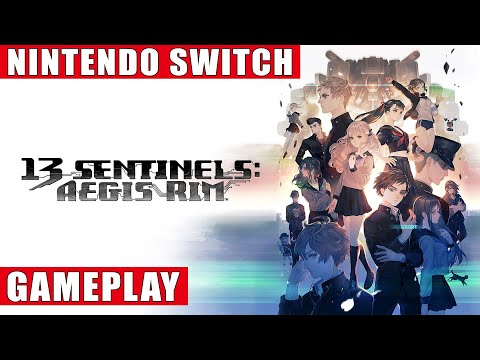
You follow thirteen different high school students whose stories you can play in almost any order, each one slowly revealing pieces of a much bigger science fiction mystery. Periodically you switch to a separate mode where those same characters pilot giant robots in real-time battles against an invading army. The two halves feel very different, and figuring out how the stories connect is the main draw.
Gameplay video
More 13 Sentinels: Aegis Rim gameplay on YouTube →Ready to play 13 Sentinels: Aegis Rim?
Grab a physical or digital copy from Amazon — prices and availability update live.
This is an affiliate link. As an Amazon Associate we earn from qualifying purchases, at no extra cost to you.
Screenshots & review notes

The verdict
Rarely does a game ask this much of your attention and reward it so fully; the way thirteen threads eventually interlock is a genuine feat of writing. Nothing else on Switch reads quite like it.

The mechanics
Story sections are pure visual novel, while the mech battles play out as tense real-time strategy on a shared map, and the contrast keeps the whole thing from feeling one-note.

Presentation
The hand-painted backdrops recall old anime cel work and the score matches that wistful, retro-futurist mood perfectly. It runs cleanly on Switch despite dense, layered scenes.

Staying power
This is a one-and-done narrative experience rather than something built for replays, but that single journey is unforgettable. Strongly recommended to anyone patient with nonlinear storytelling.
Frames captured from the gameplay video above; notes are our own take on the game.
What it's like to play
You follow thirteen different high school students across different time periods in a side-scrolling story mode, walking between a handful of locations and talking to characters to unlock story scenes in whatever order you choose, gradually assembling a much larger science fiction plot out of pieces that do not initially seem connected. An in-game archive keeps track of story fragments, characters, and terms you have encountered, which helps when the plot starts jumping between time periods and perspectives. This half of the game plays almost like reading a very good book that lets you pick which chapter to read next.
Separately, a real-time strategy mode has you controlling giant mechs piloted by those same students, viewed from above, positioning them and using weapons like missiles or a defensive EMP field to hold off waves of attacking kaiju-like monsters across a level. This combat is simpler than a dedicated tactics game, focused more on positioning and resource management than deep unit customization, and you can move freely between working on the story and playing combat missions at your own pace. A full playthrough covering both halves runs around thirty hours.
The jump between the beautifully drawn story scenes and the more abstract, simplified combat maps can feel jarring, and some players prefer one half clearly over the other. The story deliberately withholds context for a long stretch before its threads start connecting, which requires patience to stick with. Players who enjoy puzzle-box science fiction stories and do not mind lighter strategy combat on the side will get the most out of it.