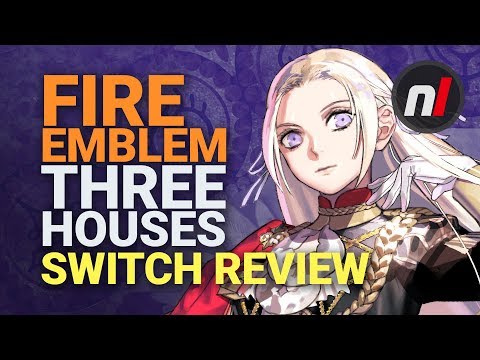
Half the game is teaching at a military academy, where you pick classes for your students, eat lunch with them, and get to know their personalities. The other half is turn-based battles on a grid, where you move each unit one square at a time and think carefully, because a character who dies can be gone for good. Which students you choose to teach changes which side of a war you end up fighting on.
Gameplay video
More Fire Emblem: Three Houses gameplay on YouTube →Ready to play Fire Emblem: Three Houses?
Grab a physical or digital copy from Amazon — prices and availability update live.
This is an affiliate link. As an Amazon Associate we earn from qualifying purchases, at no extra cost to you.
Screenshots & review notes

Overall
This entry proved the series could carry a full social sim on its back, and the gamble paid off with one of its most beloved casts.

Moment to moment
Teaching mechanics add welcome texture between fights, though the turn-based battles themselves can feel slow-paced next to the series' faster earlier entries.

Art and atmosphere
Garreg Mach's monastery has a warm, lived-in quality, and the voice work sells every character relationship even when the map animations look dated.

Worth your time?
Three distinct routes practically demand multiple playthroughs, making this one of the most replayable entries in the series for anyone with the patience for it.
Frames captured from the gameplay video above; notes are our own take on the game.
What it's like to play
This game has two halves that alternate. In one, you are a teacher at a military academy. You walk around the monastery grounds, choose which skills each student trains this week, eat meals with them, garden, fish, hand out lost items, and generally get to know a cast of young nobles who all have their own worries and ambitions. The better you know someone, the better they fight, and the more of their story you see.
The other half is battle, and it is turn-based on a grid. You move each of your units one square at a time, checking who can reach whom, whether the terrain gives a defence bonus, and which weapon beats which. It is a chess match rather than an action game, and you can take as long as you like on each turn. The signature tension is permadeath, where a character who falls is gone from the story permanently. You can turn that off, and there is a rewind ability that lets you undo a handful of mistakes per battle, so it is far more forgiving than it sounds.
Early on you pick one of three classes to teach, and that choice sends the story down a dramatically different path when a war breaks out and your students end up on opposing sides. People replay it two or three times to see the other perspectives, which is why the total time for the full picture runs past two hundred hours. A single playthrough is around sixty. If you enjoy slow tactical thinking and character drama, it is the standout of its genre on the system.