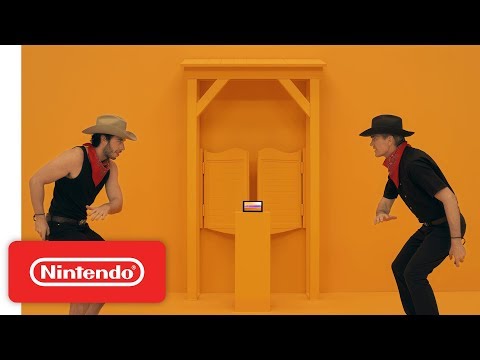
You put the controllers in your hands but keep your eyes off the screen, since most of these minigames are about reacting to your opponent sitting across from you rather than watching a display. Games include things like a quick-draw duel or balancing an invisible object using motion controls alone. It plays best as a party icebreaker with a group in the same room, and it has very little to offer if you are playing alone.
Gameplay video
More 1-2-Switch gameplay on YouTube →Ready to play 1-2-Switch?
Grab a physical or digital copy from Amazon — prices and availability update live.
This is an affiliate link. As an Amazon Associate we earn from qualifying purchases, at no extra cost to you.
Screenshots & review notes

Overall
As a game to actually sit and play alone, this barely qualifies, but as a party icebreaker it still occasionally works its charm.

Moment to moment
The face-to-face duels rely entirely on physical reaction and bluffing rather than any traditional gameplay skill, which is either delightful or baffling depending on your group.

Art and atmosphere
There's barely any on-screen visual identity to speak of, since the whole point is looking at your opponent instead of the television.

Worth your time?
It's a novelty best reserved for parties with people unfamiliar with games, and it has almost no legs beyond a few enthusiastic nights.
Frames captured from the gameplay video above; notes are our own take on the game.
What it's like to play
You and a friend each hold one Joy-Con controller sideways and stand facing each other rather than the television, which is the whole point here since the screen is mostly there to give instructions rather than show gameplay. A voice explains a simple scenario, like drawing a pretend gun and shooting first, or milking a virtual cow by shaking the controller in a milking motion, and the Joy-Con's tiny rumble motor and camera do the rest to figure out who did it better. There are twenty-eight of these little games in total, and picking one and reading the quick instructions takes only a few seconds. There is no traditional controller stick or button practice needed, since most games ask for one physical motion.
A typical game lasts well under a minute, so a session usually means cycling through several games back to back with whoever is in the room, laughing more at each other's reactions than at anything on the screen. Some games, like a quick-draw duel or a game where you guess how many balls are hidden in a box by feel, hold up to repeat play, while others are essentially one good laugh and then forgotten. There is no real scoring or progression to chase beyond bragging rights between rounds. It works best as something you pull out for ten or fifteen minutes when people are already gathered rather than a game you sit down to for a whole evening.
Session to session, this lives or dies entirely on who is in the room, since playing alone offers almost nothing. What will likely frustrate you is how quickly you run through the strongest games and are left with several that only really land once. It is best thought of as an icebreaker to hand to non-gamers at a party rather than a game to buy expecting lasting depth, and it is worth picking up cheaply rather than at full price.