
You play a detective in postwar Los Angeles, walking through crime scenes to collect evidence and then questioning suspects, watching their faces closely to decide whether they are lying. Getting an interrogation wrong can send a case in the wrong direction, so paying attention matters more than fast reflexes. It has a heavy, moody atmosphere closer to a black and white crime film than an action game.
Gameplay video
More L.A. Noire gameplay on YouTube →Ready to play L.A. Noire?
Grab a physical or digital copy from Amazon — prices and availability update live.
This is an affiliate link. As an Amazon Associate we earn from qualifying purchases, at no extra cost to you.
Screenshots & review notes
The short version
A fascinating, flawed experiment that's aged in odd ways, its detective fantasy still compelling even when the open world around it feels thin.

In the hands
Interrogations are the highlight, reading faces for tells in a way few games attempt, though the actual case-solving offers less freedom than it first suggests.

Look and sound
Motion-captured performances remain a genuine technical marvel, though everything surrounding those faces looks distinctly last-generation on Switch.

The long haul
Worth playing once for the central gimmick alone, though its slower pacing and dated driving sections may test the patience of impatient players.
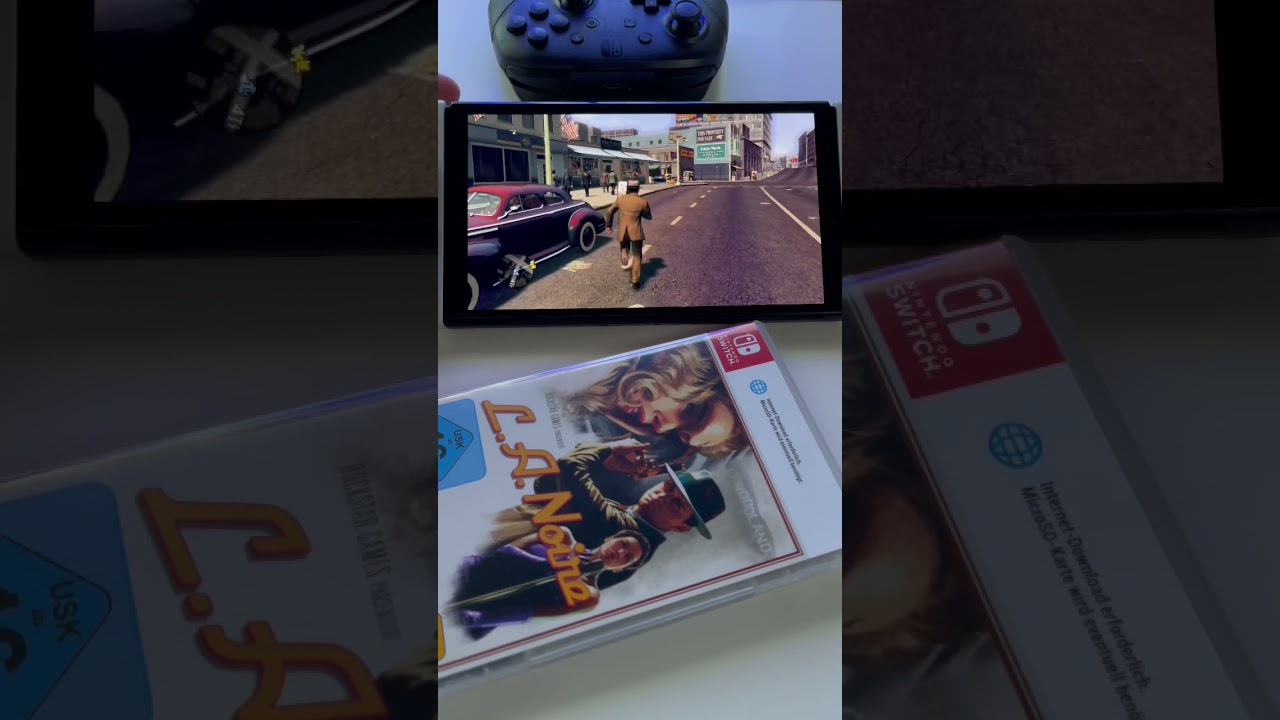
Frames captured from the gameplay video above; notes are our own take on the game.
What it's like to play
A detective game set in 1947 Los Angeles, where you climb the LAPD ranks from patrol to homicide, and the facial capture technology lets you read suspects' expressions during interrogations. Judging truth, doubt, or lies from a nervous twitch is the core mechanic, and it remains unique. Crime scene investigation and the sprawling period city create real atmosphere.
The cases escalate across desks, with the homicide arc forming a serial killer narrative, and the writing captures noir tone convincingly. The Switch version includes all DLC cases and touch controls for examining evidence. Driving across the faithfully recreated city is a pleasure in itself.
The doubt option's unpredictable aggression is a known design flaw, and the open world is beautiful but empty of things to do. Action sequences, chases and shootouts, are the weak point. As a distinctive detective experience and a piece of technical history, it is fascinating and often brilliant.